How to buy your first online business in Nigeria
Buying a working project can save you a year of building. Here is how to choose one, check it properly, agree a fair price and take it over safely.
Why buy instead of build
Building from nothing takes months before the first customer pays. A working project already has the product, the users and often the revenue, so you start from there instead of from a blank page.
Buying isn't automatically safer. You take on the project's problems along with its customers, so most of the work is in checking it well. The rest of this guide is about how to do that.
Decide what you're looking for
Before you browse, write down four things:
- Your budget, including enough money to run and grow the project for six months after you buy it.
- What you can run yourself. A content site needs writing. A software product needs someone who can fix the code, or the money to pay someone who can.
- How much time you have each week.
- The kinds of projects you understand. You'll judge a market you know far better than one you don't.
On Prow: set an alert with your category and price range. Matches show on your alerts page the day they're listed, and email alerts are coming soon.
Read the numbers properly
Revenue is the first thing everyone looks at, and the easiest to misread. Check each of these:
- Where the numbers come from. A screenshot can be edited. Ask for numbers from the source: the payment account itself.
- Recurring or one-off. Subscriptions that renew every month are worth more than one-off sales, because they're likely to continue after you take over.
- The trend. Look at 6 to 12 months, not one good month.
- Customers leaving. If many customers cancel each month, the revenue is harder to keep.
- Costs. Hosting, tools, ads, freelancers and the seller's own time. Profit matters more than revenue.
- One big customer. If one customer pays most of the revenue, losing them would hurt badly.
- Where customers come from. Paid ads you'll have to keep paying for, search, word of mouth, or one partnership that belongs to the seller.
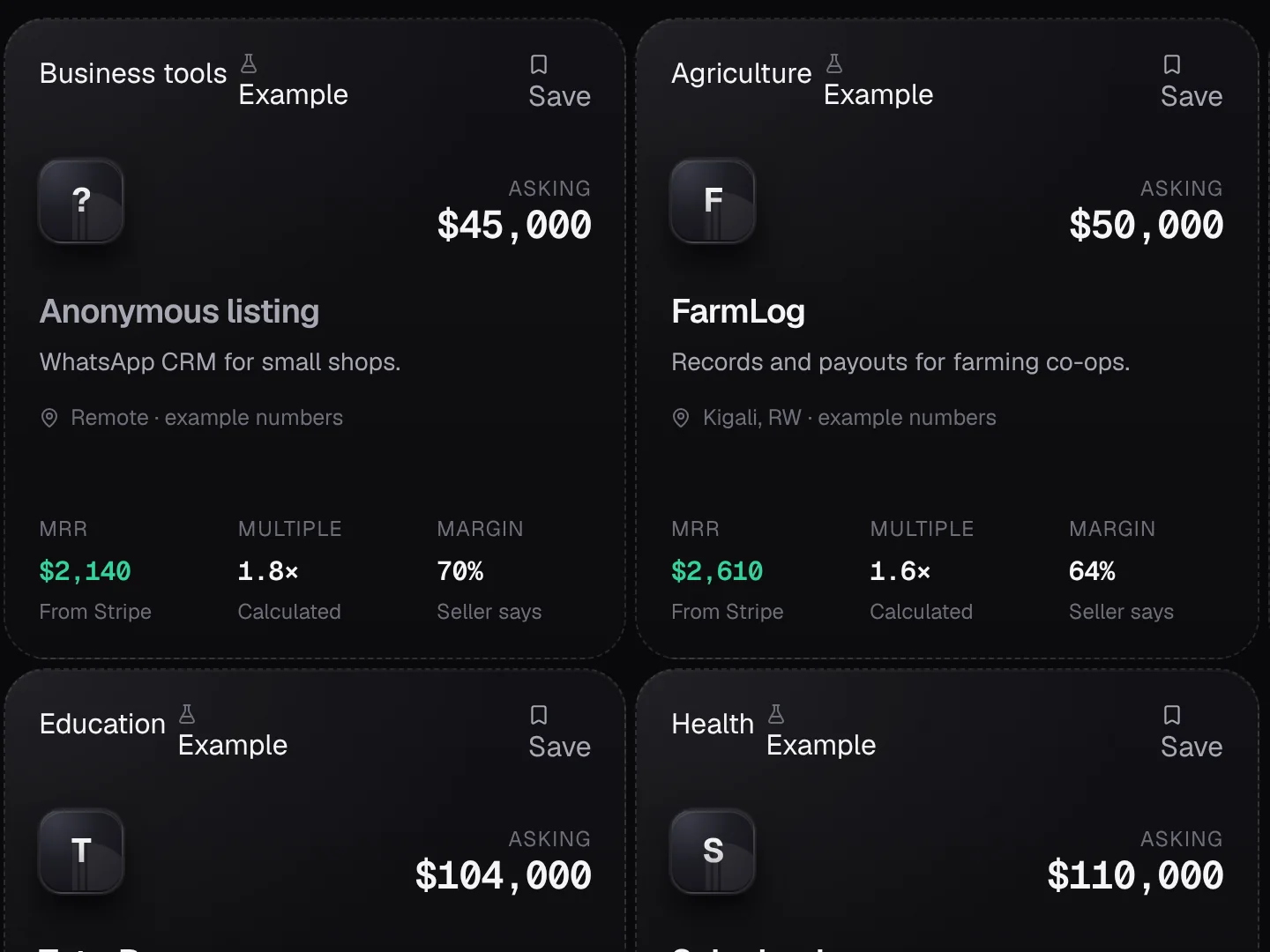
On Prow: revenue marked “From Stripe” is pulled straight from the seller's Stripe account with a read-only key, so nobody typed it in. Anything marked “Seller says” was typed by the seller and is worth checking in the data room.
Work out a fair price
Small online businesses are usually priced as a multiple of their yearly profit or revenue. The multiple is higher when revenue is recurring and growing, customers stay, and the project needs little work to run. It's lower when the revenue depends on the seller personally, on one customer or on one channel.
Compare it with similar projects, ask the seller how they reached their asking price, and decide the most you'll pay before you start talking. It's much easier to walk away from a number you set in advance.
Talk to the seller
Some good questions to ask:
- 1.Why are you selling?
- 2.How many hours a week does it take, and what do you spend them on?
- 3.What breaks, and how often?
- 4.Who are your best customers, and why do they stay?
- 5.What isn't in the numbers? Refunds, unpaid invoices, a big customer about to leave.
- 6.Who wrote the code and made the design? Do you own all of it?
- 7.Will you help for a few weeks after the sale?
Listen for calm, specific answers. A vague answer isn't a reason to walk away, but it is a reason to look more closely at that part.
On Prow: you can ask the seller questions privately from the listing page.
Check everything before you pay
This step is called due diligence. Sign the seller's non-disclosure agreement (NDA), then go through their documents and make sure you see:
- Access to the code, and proof that it runs.
- Who owns the domain, and when it renews.
- The hosting, email, app store and other accounts that will move to you.
- The payment account, and how customers will be moved over to you.
- The customer list and any contracts.
- Licences or permits the project needs, and whether they can change owner.
- Who owns the code, design and content. Co-founders and freelancers should have signed their rights over.
- Taxes owed and any debts tied to the project.
If something matters to your decision, ask for proof, not a promise.
On Prow: once you're a verified buyer, you can sign the NDA and open the seller's data room from the listing page.
Make a clear offer
A good offer leaves nothing to guess. It says:
- The price.
- Exactly what's included: code, domain, accounts, customers, social pages, content.
- How long the handover takes.
- How long the seller will help after the sale.
On Prow: offers are for one price, paid in full. Prow doesn't use earn-outs or payment plans.
Pay through escrow, never directly
Don't send money straight to a seller you don't know. With escrow, your money is held by an escrow company until the handover is done. You confirm each item on the handover list, and only when everything is confirmed is the money released to the seller.
Prow's fee is 1.5% from each side (at least ₦5,000 each), and only when a deal closes. The escrow partner's own fee is separate and shown before you pay. See pricing for the details.
On Prow: escrow is being set up with our escrow partner. Until it's switched on, you can find projects, read verified numbers, sign NDAs, ask sellers questions and make offers, but no money moves through Prow yet.
Take over safely
On handover day, go through the list with the seller:
- Move the domain into your own registrar account.
- Transfer the code and the hosting.
- Move the payment account, or move customers to yours.
- Take over the email, app store, social and analytics accounts.
- Change every password and remove the seller's access.
- Check that the product still works and customers can still pay.
Then confirm each item. Ask the seller to stay reachable for at least 30 days.
Your first 90 days
Change as little as possible in the first month. Learn why customers pay, answer support messages yourself, and fix what's broken before you add anything new. Growth comes after you understand what you bought.
The short version
- Your budget covers six months of running costs.
- Revenue is checked at the source, with recurring and one-off income separated.
- You've seen 6 to 12 months of revenue, cancellations and costs.
- You've asked the seller the hard questions.
- Code, domain, accounts and ownership are all checked.
- Any licence that needs approval to change owner is listed.
- Your offer states the price, what's included and the handover.
- You pay through escrow, never directly.
- Every item is confirmed before you sign off.
This isn't legal or financial advice. Speak to a lawyer and an accountant before you sign anything.