What is a project worth with no revenue?
No revenue doesn't mean no value. If people use what you built, a buyer can see a business in it. Here is how buyers think about the price, and how to show your numbers so they believe them.
What buyers pay for when there's no revenue
A buyer is paying for something they can't easily get on their own. Without revenue, that usually means one of these:
- Users who come back. Getting people to try an app is hard. Getting them to return every week is harder.
- An audience or a channel, like a big WhatsApp community, a social following or strong search traffic.
- Working code that would take months to build again.
- A name, a domain or a licence that is hard to get.
The more of these you have, and the harder each one would be to copy, the more a buyer will pay.
The numbers buyers look at
Buyers look past big totals. These are the numbers that tell them whether the users are real and will stay:
- Monthly active users: people who used it in the last 30 days. Downloads and sign-ups count for much less.
- How many come back: of the people who signed up in a month, how many still use it a month or three months later.
- Growth: is it going up month by month, and does it still grow when you stop posting about it?
- Where users come from: word of mouth and search are worth more than paid ads or one viral post.
- What it costs to run: hosting, tools and how many hours a week you spend on it.
How buyers work out a price
There is no standard multiple for projects without revenue, because there is no revenue to multiply. Most buyers work it out from two questions:
- What would it cost me to build this myself? The time and money to build the product again, at the same quality.
- What would it cost me to get these users myself? What ads or marketing would cost to reach the same number of active users.
Then they take some off for risk: users who might leave after the sale, code only you understand, or a channel that depends on you personally. If you can show the users will stay without you, the price goes up.
A buyer will also ask how it will make money. You don't need the answer, but a clear idea helps. For example: “Ten percent of users asked for a paid plan”, or “Businesses already message us about advertising.”
Make your numbers easy to check
Screenshots are easy to fake, and buyers know it. Make the numbers easy to check instead:
- Keep an analytics tool running (Google Analytics, Firebase, PostHog or similar), so you have months of history, not one good week.
- Export the monthly numbers and the return-rate table, not just one total.
- For mobile apps, keep the App Store and Play Console reports for installs and active devices.
- Offer serious buyers read-only access to your analytics during due diligence, under your NDA.
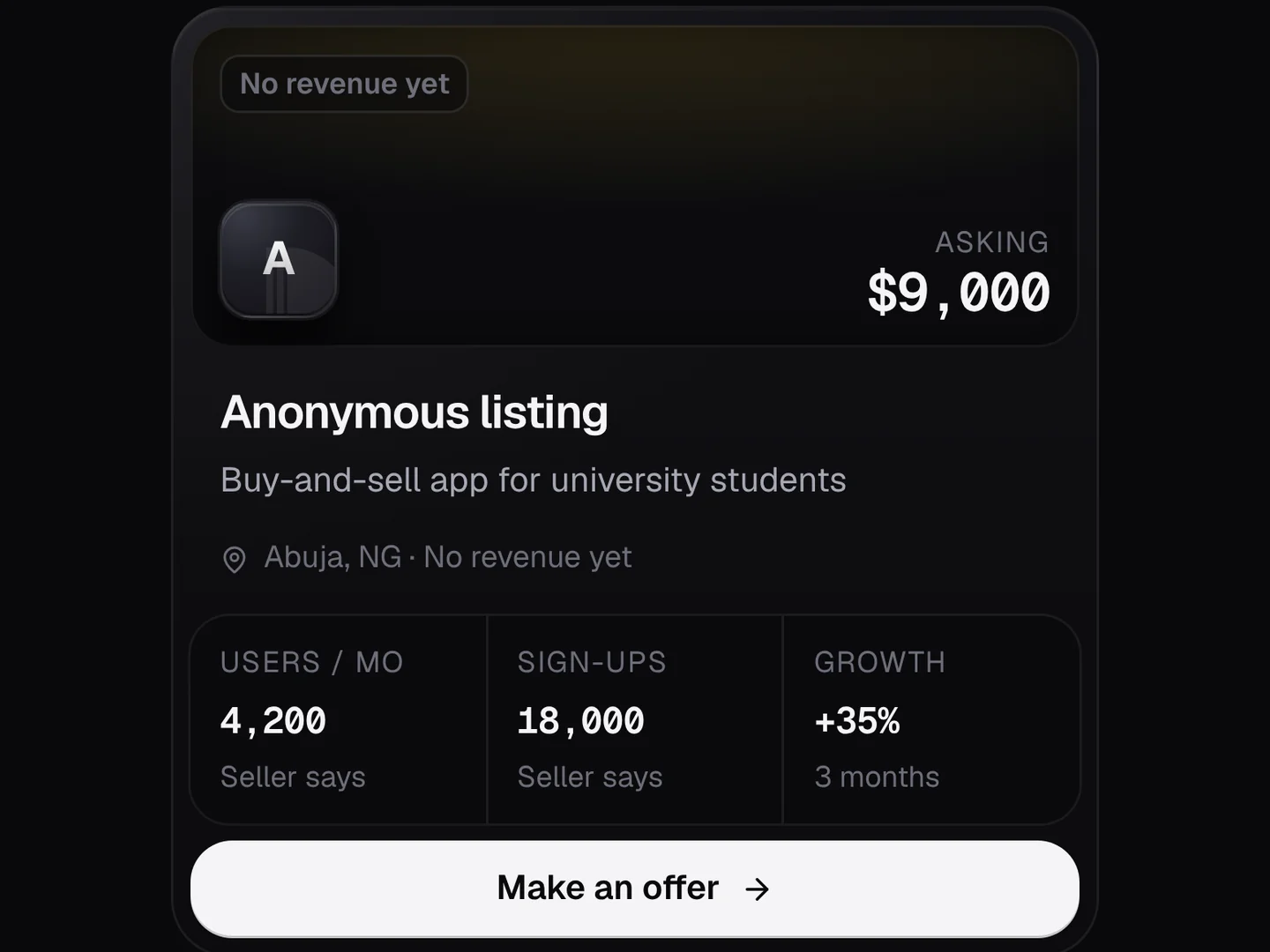
On Prow: your user numbers show on your listing marked “Seller says”, because you typed them. Put the exports and screenshots in your data room so buyers can check them against each other.
What lowers the price
- Users from one big spike that faded.
- Growth that only comes from paid ads.
- Lots of sign-ups that never came back.
- A product that depends on one platform changing nothing, like a single app store feature or one social network's rules.
- Everything living in your head, with nothing written down for the next owner.
Listing it on Prow
Projects without revenue list on the Early-stage plan: $6 (₦10,000), paid once. There is no price cap, but if you ask a lot, review takes a closer look for income that isn't showing. If your project starts earning and you connect revenue, the listing moves to Basic and the difference is due.
On Prow: add your monthly active users, total sign-ups and growth on the listing page. It's all on one page.
The short version
- You can say what a buyer gets that's hard to copy: users, an audience, code, a name.
- You know your monthly active users and how many come back.
- You have months of analytics history, not one screenshot.
- You know what it costs to run and how many hours it takes.
- You have an idea of how it could make money.
- Your proof is in the data room before the first buyer asks.
This isn't legal or financial advice. Speak to a lawyer and an accountant before you sign anything.